Views: 0 Author: Site Editor Publish Time: 2026-08-06 Origin: Site
1. Selection Guidelines
Proper selection of inert alumina ceramic ball size, alumina purity, and mechanical grade should be based on reactor design parameters and actual process conditions.
1.1 Size Selection
| Size Range | Advantages | Disadvantages |
| Small (3–6mm) | Larger specific surface area, better filtration efficiency, finer flow distribution | Higher bed pressure drop |
| Large (13–50mm) | Effectively reduces bed pressure drop, higher flow capacity | Weaker filtration/impingement interception capability |
Recommendation: Most engineers use hydraulic calculations to balance pressure drop and filtration efficiency to determine the optimal size for their specific unit.
1.2 Purity Grades (Alumina Content)
Different alumina content levels correspond to different operating conditions:
| Grade | Al₂O₃ Content | Applicable Conditions |
| Low Alumina | 17%–26% | Mild conditions, low temperature, non-corrosive |
| Medium Alumina | 50%–80% | Moderate temperature, mildly corrosive environments |
| High Alumina | 90%, 92%, 99% | High temperature, highly corrosive, severe process conditions |
Recommendation: For high-temperature and corrosive media containing chlorine or sulfur, high-alumina series products should be given priority to ensure long-term operational stability.
2. Frequently Asked Questions
Q1: What is the difference between inert ceramic balls and catalyst particles?
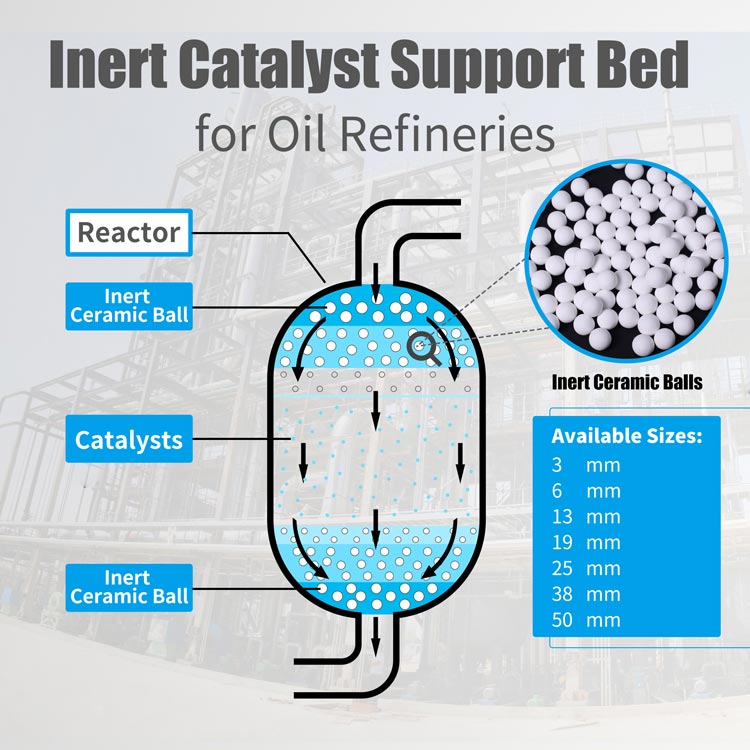
Inert ceramic balls do not participate in any chemical reactions – they serve only as physical supports, flow distributors, and impurity filters. Catalyst particles, on the other hand, contain active metals such as platinum, nickel, or cobalt, and are the core components that drive target chemical reactions. The two have completely different functions and cannot be substituted for one another.
Q2: How often should inert alumina ceramic balls be replaced?
Under normal operating conditions, as long as there is no significant mechanical damage or severe fouling, the service life of inert ceramic balls can cover multiple catalyst replacement cycles, typically lasting 3–5 years or even longer. It is recommended to inspect the ceramic balls during each catalyst changeout. Replacement is only necessary if obvious wear, cracking, or heavy contamination that cannot be removed by cleaning is found.
Q3: What are the consequences of selecting the wrong ball size?
Incorrect size selection can lead to the following issues:
Too small: Excessive bed pressure drop, increased energy consumption
Too large: Poor flow distribution, reduced catalyst utilization
Mismatched sizing: Excessive gaps cause catalyst particles to migrate downstream, leading to catalyst loss and equipment fouling
Recommendation: Always follow the reactor manufacturer's recommended size range and perform bed loading density and pressure drop calculations to ensure optimal performance.
Q4: Can ceramic balls reduce catalyst poisoning caused by heavy metals?
To some extent, yes. The porous structure of ceramic balls can capture heavy metal particulates and coke fines before they reach the catalyst. However, it should be noted that ceramic balls cannot remove metal ions dissolved in the feedstock, nor can they completely eliminate chemically active toxins such as arsenic or lead. For these impurities, dedicated guard beds or feedstock pretreatment units are required.
Welcome to contact us for technical support and customized solutions.
E: info@chemxin.com
www.chemxin.com